Tuesday, July 17, 2012

Just the half of it


Now that our work in Mahale has finished up, it’s time to start field sampling in Kigoma! (I’m trying to be enthusiastic here (as evidenced by the careful placement of that exclamation point), but it’s actually really hard to be here after having seen the mostly-pristine beauty of the mountains). So after one very luxurious day of doing Absolutely Nothing (it was all I hoped it could be and more!), we fueled up the engines and inflated the boats and were back to the grind of collecting data.

Since we didn’t get a chance to get in the water before we left Kigoma the first time (remember all the residency permit issues early on??…), a boatload of work awaited us upon our return to reality. Step one was to hit each of our 12 sites for what Team McIntyre affectionately calls “Weeklies.” Since I’m “boat girl” during this event, for me it’s an exercise in sunburn, dehydration, and testing the limits of my bladder. 

Boat girl and water boy
Basically Benja and I hightail it to a site (Pete came along this week for good measure), and while we dangle a sonde off the side of the boat, Ben hops in and fills some syringes with lake water for me to filter onboard. He then free dives down to 15 feet and carefully places IER’s (Ion Exchange Resins) onto the benthos. 

IER's attached with some coated wire, zip ties, and rubber bands from the CFL mailboxes.
 
Tanganyika is special for many reasons, but The Big Question we’re trying to answer is how such a nutrient-poor lake is so productive and can support such high species diversity. It’s a real head-scratcher, but water sampling and IER’s tell us a weekly story of how many nutrients are out there, available for uptake.

The second big task was to get the thermistor chain in the water and recording the temperature of the lake at various intervals down to 120 meters. 

As a totally unrelated aside, I’d like to point out that at its deepest point, Tanganyika is over 1600 METERS. A MILE. Remember field day in elementary school when the gym coach made you run around the track 4 times? For whatever reason, that’s always been my mile-reference for life, and that’s a damn long way down.

Going back to the fact that this lake is nutrient-scarce, one of the hypothesized sources of nutrients is upwelling events that bring all the (good) stuff that has sunk to the bottom of the lake back to the top. Those events are associated with slight changes in temperature (deep water is cooler), and the idea is that we will be able to watch it happen by putting loggers at various depths and downloading the digital story.
 
We made it almost all the way to the drop location before Benja realized he didn't actually activate the loggers. Pete doesn't mess around when it comes to safety (as evidenced by his wearing of the PFD indoors...)
 
In a perfect world, you’d be able to slap a buoy onto the line that holds your NINE THOUSAND DOLLAR piece of equipment, but here in Africa that would be the equivalent of a giant neon sign saying “COME STEAL ME! I AM VALUABLE!!!” So there is no surface buoy, and the buoy holding the chain is sunk to 30 feet. It takes a GPS, a good eye, and a whole lot of luck to find it again (read: a miracle)…

Go time! Pete lowers the Super Heavy Anchor over the side, and I slowly lower the rope through a series of carabiners.
It mostly went well, and after following Ben’s advice to keep it simple, it’s in the lake, doing its thing, collecting data. Last year we celebrated our successful endeavor by jumping off a cliff; this year (since The Boss was along and didn’t want us engaging in life-endangering activities) I gave the guys knucks. Goooo, team.

Totally unrelated picture to this post, but I saw this boat out during Weeklies. Biggest life raft ever? Maybe...

Wednesday, July 11, 2012

Why we’re here


Previous field research for the Lake Tanganyika Ecosystem Project has been based out of Kigoma, Tanzania’s biggest port on the lake. But earlier this year, Pete and Yvonne were approached by The Nature Conservancy to assess our interest in a field collaboration with them, Pathfinder International, and Frankfort Zoological Society at Mahale Mountain National Park.

When Pete asked if Benja and I were game, the answer was a unanimous HELL, YEAH.

Mahale is probably the most remote and least-visited of Tanzania’s national parks, mainly because it’s so damn hard to get there. It’s mostly frequented by the insanely wealthy who arrive via airplane (rooms at the 2 nearby safari camps cost $1000/ and $500/night respectively) and adventurous Lonely Planet types who brave their chances with local $2 water taxis (not a typo. Actually TWO dollars…) and stay at the park camp for $30/night. Along with Gombe, the park is famous for its population of chimps (the largest in all of Africa!), but it’s also home to a host of all the other wild animals and plants people come to Africa to see.

The purpose of our involvement is to develop a baseline for what conditions are like in the nearshore community before the instigation of the Tuungane Project (the giant collaboration between the 3 entities).

The reason the Tuungane project exists is ultimately to protect this incredible place, since preliminary household surveys revealed depressing statistics regarding the villages adjacent to the park:

1.       Half the population in the villages is under 15 years old, and a virtual population bomb awaits (a large population coming up with limited resources to support them.)
2.       There are 6.7 people/family (that’s the highest in the world…).
3.       130/1000 children born since 2006 didn’t survive until their 5th birthday.
4.       The villages have poor access to health care, and family planning is virtually non-existent.
5.       Household income comes from farming and fishing, and herein lies the problem:
Farmers clear the surrounding forest of trees to make plots for growing crops. Deforestation leads to increased sedimentation, and all that loose sediment ends up in the lake. Extra sediment covers the algae growing on the rocks that supports a large number of the grazing fish species (and the rest of the greater food web) and chokes out fish breeding sites. Fewer fish that can’t breed = fewer fish in the ecosystem = fewer fish to catch.
So they cut down more trees to make bigger plots of land to grow more food (a dangerous and unsustainable spiral).

I’ve heard this story before, as it’s a pretty common phenomenon worldwide. But even though I’ve read about it, it broke my heart to actually see it. We picked research sites inside and right outside the park, and the difference was astounding.

So our role is an important one, and it feels really great to be part of a team that will hopefully have a positive impact on this gorgeous piece of paradise.  

And over the course of 13 days, it’s become one of my favorite places in the Whole Wide World. I honestly don’t know where to begin, but here are a few of the wild events that became the new “normal” for us during our stay.

1.       Animals. Everywhere. All the time. Baboons on the roofs of our bandas, stalking and encircling us while we ate our meals outside, and chasing each other through the camp. Warthogs and bush pigs digging through the garbage heap outside the kitchen. Hornbills and kingfishers, vultures and herons, and countless other birds I couldn’t identify doing flyovers and fishing while we worked. Duiker and dik dik and mongoose silently maneuvering through the forest.

2.       Two hippos set up shop on the beach where we launched our boat each morning. We gave them a wide berth when taking off for work, and they (fortunately) never gave us any trouble.

3.       CHIMPS came down to the water and curiously watched us work collecting specimens for stable isotope analysis. Another small family group was waiting for us at the boat launch when we arrived at home one night after a long field day. We followed them through the forest in our wetsuits…


4.       Water cobras swam with us each day and mostly just tried to avoid us. Spottings are a Very Rare Phenomenon in Kigoma, but here they were spotted by multiple team members on any given day. They Are Awesome.

I probably wouldn't be so calm if this one wasn't dead. He got caught in a gillnet, and we took the opportunity to sample him for the stable isotope food web (and look at his fangs up close).


5.       The cichlid community was larger in size, occurred in higher densities, and was more diverse than anything we’d seen previously. It was pure bliss getting to swim and observe all of the incredible fish that live in the protected paradise of Mahale. I never want to get out of the water…
This picture doesn't do it justice, but it's all I have at the moment. It's a giant emperor cichlid (the biggest cichlid!) at 10m, and I've never seen any this big.

6.       CROCODILES! I never saw one of these, but one of our study sites was the place the park takes visitors when they want to guarantee a croc siting. Pete spotted one during a night dive (Our Fearless Leader takes wild chances at times…), and the WSU team saw a little guy before they started their diving for the day.

Our fearless leader...


Calling it a day and heading home
7.       Most people don’t realize it, but this lake truly has magical properties. It has the power to take away my crabbiness by the simple act of dipping my sore and exhausted soul into its waters. THAT is a miracle. 

Monday, July 2, 2012

Just another day in the field…


There is no typical day in the field I guess…so this might be a recurring feature of the blog.

But what we do on any given day depends on a few things:

1.       Which project goal we’re trying to accomplish
2.       If our gear is cooperating
3.       If the weather is cooperating
4.       If our guts are cooperating

So here it is…one random field day during the Mahale excursion:

Monday, 2 July 2012

7:30am – Wake up. Head to breakfast and see what Hassan has cooked up. 

8:30am – Start packing up the gear we’ll need for the day (snail quadrats, fish quadrats, plum lines, whirl pacs, dive tanks, BCD’s, regs, snorkel stuff, wetsuits-that-reek-of-urine, our lunch!) into the smallest space possible and walk it down to the water.

8:45am – Head down the beach to boat storage with Pete. Watch in horror as Dakota (one of our trusty park staff) mouth-siphons fuel from the 200L barrel into our 25L tank. Mix in the 2-stroke oil and haul it and our motor down to the Zodiac. Pump up the keel of the Zodiac again because it’s always flat (must find mysterious small leak…). Guts feel…off. Take 2 Pepto and pack 2 more into dry bag Just In Case.

9:30am – Finally leave camp with Pete and Vanessa and attempt to get the Zodiac to plane (Aside: Pete is OBSESSED with getting our boat to plane. It usually involves asking us to move a few inches towards the bow or stern 100 or so times until we are moving as quickly as possible to save transit time.)

[FBN: “If you want Pete to go fast, put him in a boat.” –Yvonne Vadeboncouer]

9:45am – Stop at park headquarters so Pete can show me where the freezer is located for future sample dumps. Keeping stuff frozen here has been a real challenge, and in the end we had to bring our own freezer from Kigoma. Seriously. 

10:05am – Arrive at Site 4. Pete dons dive gear to deploy the sonde.  Sondes are Very Expensive pieces of field equipment that record the temperature, conductivity, and dissolved oxygen of the water at each of our study sites at a set logging interval.  Pete picks a spot, I lube up the bike lock and key, Pete locks the sonde to some rocks, and we hope against hope that we’ll be able to find it again when it’s time to leave (more on that in a later post…)

A successfully deployed sonde!
[FBN: Pete’s notes on where it’s located: “40m off from big white rock. Flat mix of boulder and sand. Should be pretty darn easy to see.”]

10:45am – Arrive at Site E. Deploy sonde.

11:35am – Encounter the WSU team on their way back to camp because they forgot a crucial piece of field sampling gear. Whoops. 

11:48am – Arrive at Site E since Site C is deemed unusable. Deploy sonde. Ho hum.

12:20pm – Eat Clif bar (shameless plug for Clif bars. Please send Clif bars, Clif company…). Feel nauseous. Begin mentally playing out various scenarios of how to deal with soiling my wetsuit should it occur.

12:27pm – Arrive at Site D. Deploy new Onset logger.

1:10pm – Motor to Site B but turn around when we realize how late it is. Drive back to Site D to start sampling, but tons of fisherman have set nets since we left and we can no longer be discreet. Head to Site E instead.

1:52pm – Pete gears up again and stashes the rest of the sondes in the water until we can deploy then at a later date. I am most assuredly going to crap my pants.

2:00pm-ish – FINALLY start fish counts and snail collection. Pete lays out an 8m x 7m quadrat, identifies each fish to species, and records the number of each. It’s actually pretty incredible since there are over 300 species of cichlids in this lake. Attaboy, Pete.

Meanwhile Vanessa and I don dive gear and get ready to descend. This is her Research Experience for Undergraduates (REU) project, and I’m her dive buddy. She lays out 1m x 1m quadrats and I come along and pick up every snail I see in said quadrats. Sampling design: 8 quadrats at 3 depths (2m, 5m, and 10m; that’s ~6ft, 15ft, and 30ft for the non-metric folks reading this).

Me...pickin' snails...
 [FBN: “There are a SHIT-TON (of snails) and it takes FOREVER. Giant eel has been watching me work.”]

I found this awesome green spiky sponge growing under one of the cobbles.
3:00pm-ish – Vanessa ran out of air after the 10m snails, so I finished all the 5m quadrats solo. My head hurts (Bad air or dehydration? Hard to say…).

4:00pm-ish – Surfaced and Pete was finished with fish counts, so he snorkeled and helped Vanessa finished up the 2m snails. I descend back to 5m to collect 4 cobbles and surface to discover that a giant leech has attached itself to my hand and is in no hurry to leave. 

(Vanessa: “HOW AREN’T YOU FREAKING OUT RIGHT NOW!!!).   

We need to quantify the amount of periphyton available for the fish to graze upon at each site, so basically I pick a rock, scrub off all the algae except for a small bit I cover with a centrifuge tube cap. I then scrape the remaining algae into a pan, collect it in a whirl pac, and spin it down back in the lab when we return to camp. It’s not fun, this scrubbing algae off rocks…but whatevs. That’s why I get paid the big bucks… ;).

Voila! A nice circle of algae!
5:20pm – DONE! Watch in amusement as a fleet of (mostly) naked boys in dugout canoes inches closer and closer to Pete as he collects snails with Vanessa. I give them our leftover hard boiled eggs and bananas from lunch. Start motoring home. 

Vanessa, Pete, and their entourage
6:30pm – Arrive at home. Unload all the gear on shore. Vanessa moves things up the beach while Pete and I take the boat and motor to the shed to be locked up for the night. Things seem safer here, but we still need to make sure they don’t walk away… Rinse smelly wetsuit in the lake or there will be consequences.

7:00pm – Dinner! Guts feel marginally better. Recount everyone’s adventures for the day.

8:30pm – Start spinning down algae with hand-crank centrifuge that frankly scares the crap out of me (and no eye protection in site…). Leslie helps me acidify half of the samples with 1N HCl since in the past, half of our samples have turned to tar when we tried to analyze them for Carbon, Nitrogen, and Phosphorus content. Pete and Vanessa scrub algae off all the snails we collected today (so they can later be identified) until well after midnight. There is NO WAY I’m helping with that…

11:00pm – To bed (finally)! Fall asleep immediately.

Wednesday, June 27, 2012

This Is Africa


Whenever something isn’t going according to our well-intentioned/best-laid plans, and the Americans among us begin to lose their minds with impatience and frustration, our African counterparts calmly reply, “TIA, Ellen.” Meaning: This Is Africa.

It can drive you insane, if you let it.

So before getting into the details of how AMAZING the trip to Mahale National Park was, it’s worth a brief aside to discuss things about that trip that drove me bat-shit crazy. Case in point: transport.

Getting there: Wednesday, 27 June 2012

The powers that be said to be ready to roll at 10am; the Frankfort Zoological Society trucks finally arrives to pick us up at 1pm. 

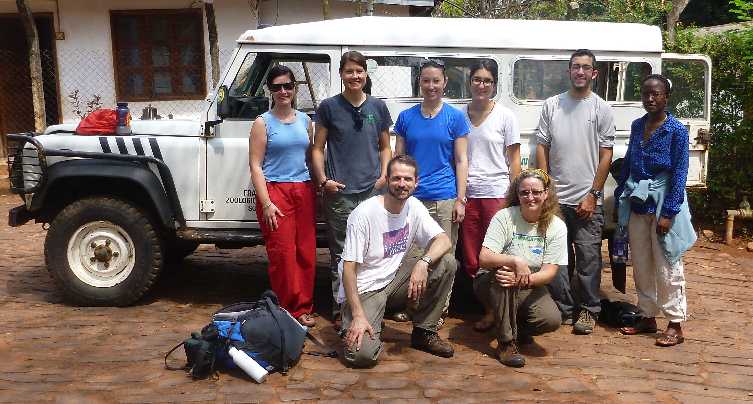
The team! Look how clean we are! (We wore the same clothes for the duration of the trip...)
[Field book note (henceforth abbreviated FBN): “Must slow the f&%k down or I’m just going to be angry all summer. I need valium.”]

We don’t leave Kigoma until around 1:45 because everyone is suddenly starving from sitting around doing nothing all morning and needs to carb load before the road trip. It is a TERRIBLE idea to eat right before a bumpy road trip of unforeseeable length, by the by…

Bounce along for 4 hours on roads that under the most generous of conditions could be called double-track bike routes in the states. Incidentally, the horn might be the most important safety feature of our Land Rover as we warn folks on bikes, chickens, goats, and small children of our presence and subsequently coat them in a fine layer of red dirt as we blast past. Try not to think about the questionable beans I ate pre-trip should they decide to leave my body abruptly from either of two very humiliating evacuation routes.

Finally arrive at the End Of The Road Village and are greeted like rock stars. Hop on a “speed boat” and we are finally back on the lake en route to the park. The engine is making a strange noise, but I faithfully pump the ball on the fuel line once per second for the next 30 minutes to assure we actually arrive. I’m wet and cold from the boat spray but am completely taken aback by the incredible beauty of the mountains and dense, untouched forest. So THIS is what the lakeshore of Kigoma looked like before everyone cut down all the trees.

Leslie enjoys her 15 minutes of fame with the local kiddos.

Arrive at our home for the next 13 days or so around 6:45. This. Place. Is. Amazing.

 
Sit around a bonfire on the beach and enjoy a starry sky free of light pollution with The Nature Conservancy, Pathfinder International, and Frankfort Zoological Society staff. Watch a scorpion commit suicide in the flames. Am overjoyed to learn that a few of the folks there are former Peace Corps Volunteers, and fun stories of former glory and escapades ensue. I LOVE LOVE LOVE finding RPCV’s at work in the world and sharing the stories…because you can only really know what it was like if you’ve done it (and African volunteers are the hardest core of the hard core ;)).

Going home: Monday, 9 July 2012 (and the wee hours of 10 July)

Made arrangements for the gear boat to arrive at 7am; it finally arrived at 10pm (PM!!!). Pete and Ben stay back to ride with the gear so they can do water sampling between Mahale and Kigoma (it’s an 11-hour journey…)

Made arrangements for the speed boat to arrive at 10am; it finally arrived at 2pm.

But whatever. We’re on our way. Say sad goodbyes to our new Mahale friends (esp. Hassan, the best cook in Tanzania) and drop by park headquarters on the way home to pick up our frozen samples. Learn that one of the transport vehicles that was supposed to meet us at the village and drive us to Kigoma got tired of waiting and went back to the big city without us. We’re now down to one vehicle and NOT ENOUGH ROOM for everyone. Saskia and Vanessa graciously volunteer to hang back and come with the gear boat (little do they know that they won’t be leaving for another 8 hours…)

Bliss out and enjoy the boat ride. Beautiful park gives way to impacted village, and the lack of trees is noticeable. Sigh.

Arrive at the village, instigate search party to find our disgruntled driver, and magically pack all of our gear into the small truck. AND WE’RE OFF. Again! Bliss out to my ipod and enjoy the sunset over the lake.

One hour into the trip, we find ourselves head to head with a giant dirt mover and no road to cross one of many bridges. Wait one hour while the power-hungry driver spins around manically in the machine, waving at us and nearly hitting road workers with the giant bucket. At some point, he realizes we actually want to CROSS the bridge, so he makes a half-assed path and we’re on our way. Again. 


[FBN: THINGS CAN ALWAYS GET WORSE.]

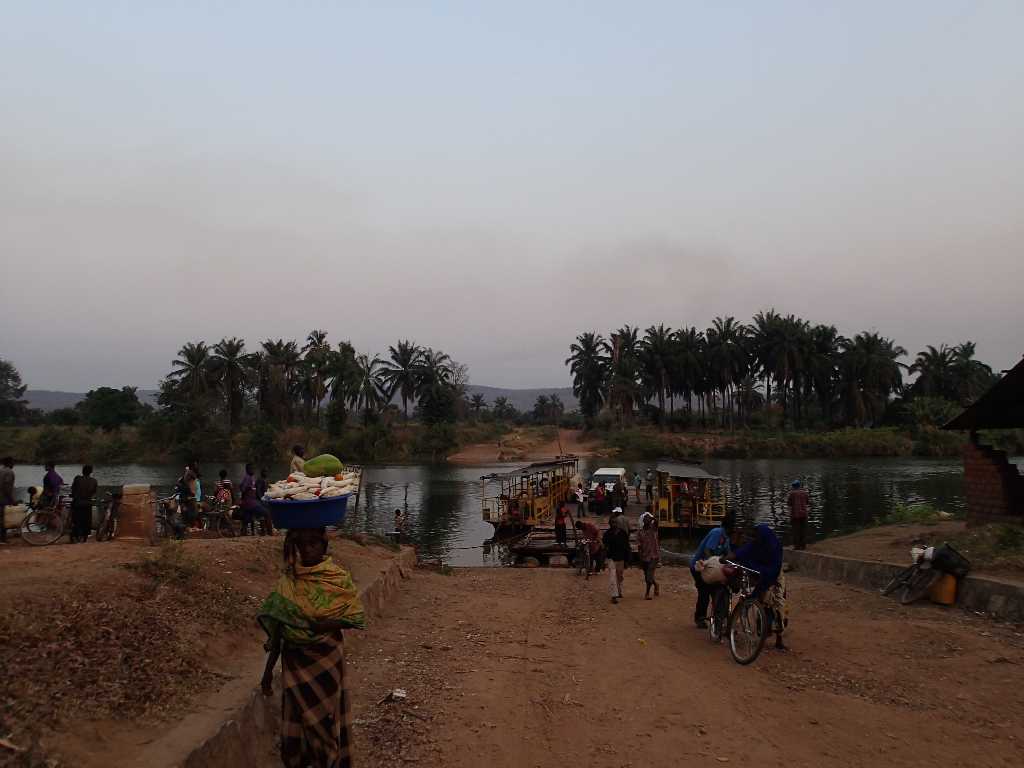
Drive ridiculously fast since (unbeknownst to us) the last ferry ride of the day crosses the Malagarassi River at 6:30. Driver makes frantic phone call to someone who convinces the ferry to wait lest we get stranded for the night on the wrong side of the river. Close call.


 And we’re off. Again.
This billboard was at the river crossing. We're not actually sure what it's for...
I took advantage of our brief hiatus from the truck to hug this tree.
 Arrive in Kigoma at 8pm.

Gear boat team arrives at 10am the next morning after a long night spooning with random strangers (Ben: “I was the little spoon.”). Pete sampled throughout the night on the hour, so arrived back in Kigoma a complete zombie.

And this is just the first phase of sampling. Kigoma sampling awaits…